Break the Silence

Links for today’s readings:

Jun 5  Read: Malachi 4 Listen: (1:06) Read: Psalms 92-93 Listen: (2:09)

Links for this weekend’s readings:

Jun 6  Read: Isaiah 1 Listen: (4:36) Read: Psalm 94 Listen: (2:08)
Jun 7  Read: Isaiah 2 Listen: (3:00) Read: Psalms 95-96 Listen: (2:37)

Scripture Focus: Malachi 4.1-6

1 “Surely the day is coming; it will burn like a furnace. All the arrogant and every evildoer will be stubble, and the day that is coming will set them on fire,” says the Lord Almighty. “Not a root or a branch will be left to them. 2 But for you who revere my name, the sun of righteousness will rise with healing in its rays. And you will go out and frolic like well-fed calves. 3 Then you will trample on the wicked; they will be ashes under the soles of your feet on the day when I act,” says the Lord Almighty.

4 “Remember the law of my servant Moses, the decrees and laws I gave him at Horeb for all Israel. 5 “See, I will send the prophet Elijah to you before that great and dreadful day of the Lord comes. 6 He will turn the hearts of the parents to their children, and the hearts of the children to their parents; or else I will come and strike the land with total destruction.”

Reflection: Break the Silence

By John Tillman

Christians and Jews agree on some writings that we both call “scripture” or “God’s Word.”

The Jewish arrangement of these texts, which we call the Old Testament, is different. We close with the shorter prophetic books, ending with Malachi. They close with Daniel, Ezra-Nehemiah (as one united book), and Chronicles. However, Christian and Jewish sources agree that Malachi was the last prophet chronologically. They also agree that prophecy fell silent following Malachi.

No prophets saw dramatic visions. No one said confidently, “Thus saith the Lord.” However, the silence wasn’t total.

People still prayed and God still answered. Wise teachers, scholars, and scribes still wrote new books. But no one held the intertestamental books with the same reverence as Malachi and his predecessors. 

God’s people, living between the testaments, recognized a difference in what they and we call “God’s Word” and the other spiritual and religious writings. The scriptures from which God had spoken become all the more important during this period of silence. 

Some silences of God might be him politely allowing us to speak first. Some silences of God are him waiting patiently for us to pass on what we already heard. Some silences of God are him asking us to spend the silence by deepening our understanding of his scriptures.

God promised on Malachi’s final page that it would not be the last page of prophecy to his people. God promised to break the silence. Jesus said John the Baptizer was, if we will accept it, the “Elijah” that Malachi promised (Luke 1.17; Matthew 11.14; 17:12). But John didn’t end the silence alone. Through Joel, God promised to pour out his Holy Spirit, not on just one man or even twelve apostles, but on a multitude of sons and daughters who would prophesy (Acts 2.16-21; Joel 2.28-32).

All God’s children are part of breaking the silence.

Are you fulfilling the promises God made through Malachi and Joel? Are you fulfilling the promises made through John the Baptizer and Jesus? Are you participating in God’s promise to break the silence?

Here’s some quick guidance as to how.

Devote yourself to prayer and God’s word. (Acts 2.42-47) Eat this book. (Eze 3.1-4; Rev 10.8-9) Open your mouth. God will fill it. (Psalm 81.10; Eze 2.7-10) Open your mind. God will transform it. (Rom 12.2;  1 Cor 2.13-16; 2 Cor 3.18)

Adjust your life to scripture, not scripture to your life. Trim your life like the wick of a lamp, (Luke 12.35; Matt 25.7-9) then watch the Holy Spirit ignite it, shining the light of truth and salvation.

Break the silence.

Divine Hours Prayer: A Reading

The Song of Zechariah

Blessed be the Lord, the God of Israel; for he has visited his people, he has set them free, and he has established for us a saving power in the house of his servant David, just as he proclaimed by the mouth of his holy prophets from ancient times, that he would save us from our enemies, and from the hands of all those who hate us, and show faithful love to our ancestors and so keep in mind his holy covenant. This was the oath he swore to our father Abraham, that he would grant us, free from fear, to be delivered from the hands of our enemies, to serve him in holiness and uprightness in his presence all our days. And you, little child, you shall be called the prophet of the Most High, for you will go before the Lord to prepare a way for him, to give his people knowledge of salvation through the forgiveness of their sins, because of the faithful love of our God in which the rising Sun has come from on high to visit us, to give light to those who live in darkness and the shadow dark as death, and to guide our feet into the way of peace. — Luke 1:68-79

– From The Divine Hours: Prayers for Summertime by Phyllis Tickle.

Read more: Destiny of Grass vs Cedars 

There are purposes for the flourishing of the wicked and one of them is that one day the world will see them fall.

Consider Supporting Our Work

Our work needs more support from people just like you. Please consider becoming a donor to support our ad-free biblical content.
The Dissonant Notes of Hope

Links for today’s readings:

Jun 4  Read: Malachi 3 Listen: (3:13) Read: Psalm 91 Listen: (1:39)

Scripture Focus: Malachi 3.13-18

13 “You have spoken arrogantly against me,” says the Lord. 
“Yet you ask, ‘What have we said against you?’ 
14 “You have said, ‘It is futile to serve God. What do we gain by carrying out his requirements and going about like mourners before the Lord Almighty? 15 But now we call the arrogant blessed. Certainly evildoers prosper, and even when they put God to the test, they get away with it.’ ” 

16 Then those who feared the Lord talked with each other, and the Lord listened and heard. A scroll of remembrance was written in his presence concerning those who feared the Lord and honored his name. 
17 “On the day when I act,” says the Lord Almighty, “they will be my treasured possession. I will spare them, just as a father has compassion and spares his son who serves him. 18 And you will again see the distinction between the righteous and the wicked, between those who serve God and those who do not.

Reflection: The Dissonant Notes of Hope

By John Tillman

Micah’s audience of exiles didn’t have a rosy, happy homecoming to Jerusalem. They met opposition and oppression, financial problems, political problems, and threats of violence. They were disillusioned, discouraged, and doubtful.

They noticed that those “winning” in life were arrogant evildoers. Two groups responded differently to these observations. God said one group spoke “arrogantly” and called the other his “treasured possession.”

One group spoke to each other, asking, “What do we gain by obeying God? What’s the ROI?” If cruelty wins, why be kind? If crooks prevail, why follow rules? They concluded that character was nice but winning was better and morality was negotiable if tradeoffs accomplished their goals. They called the arrogant blessed. God condemned the arrogant group. 

Another group “feared the Lord.” They spoke to each other, but did so “in his presence” through prayer and scripture. The Lord listened and heard their prayers. They studied and remembered those who feared the Lord and honored his name, writing out a “scroll of remembrance.”

God answered this “remembrance group” with a promise that they would see a distinction between those who were “winning” now and those who followed God’s ways.

In every age, God’s people experience the dissonance of hearing the promises of righteousness and seeing the payouts of wickedness. Corruption blooms. Integrity wilts. The arrogant gloat. The humble are shamed. We don’t resolve this dissonance by modulating our morality to modes fitting the key of corruption. We don’t give in.

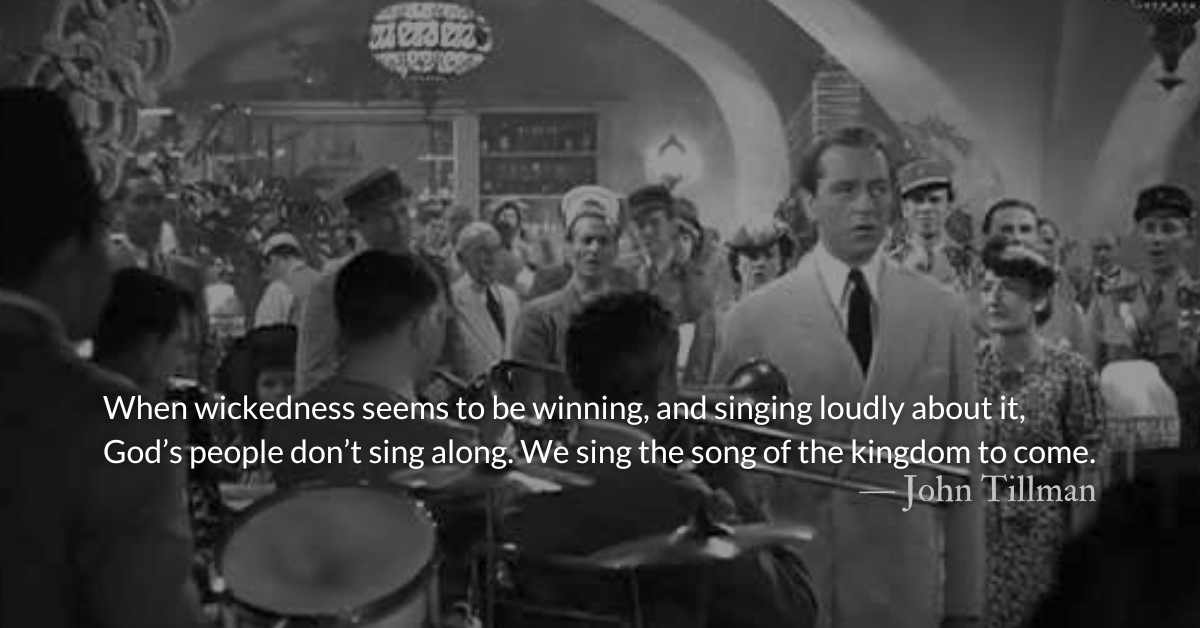
In the film, Casablanca, Nazi soldiers sing a German anthem in a crowded bar. Spurred by Victor Laslow, the band plays, “La Marseillaise,” the French national anthem. The Nazis were winning the war at that time. But the bar patrons, with tears and defiant hope, out-sing the group of soldiers.

Today, we watch this scene knowing the outcome—the Nazis lose. But in 1942, when Casablanca was produced and in 1938 when the play it was based on, Everyone Comes to Rick’s, was written, no one knew. They wrote it anyway, filmed it anyway, and sang it anyway.

When wickedness seems to be winning, and singing loudly about it, God’s people don’t sing along. We sing the song of the kingdom to come. We remember the promises of the past and anticipate joyous victories to come.

Hold out a dissonant note of hope. Sing, even through tears, and remember.

Divine Hours Prayer: The Call to Prayer

Open my lips, O Lord, and my mouth shall proclaim your praise. — Psalm 51.16

– From The Divine Hours: Prayers for Summertime by Phyllis Tickle.

Read more: Bearing Reproach

Bearing the gospel will also mean bearing reproach.
May we be faithful in both.

Read more: God’s Feathers

The psalmist portrays humans as fragile birds…easily ensnared by grift, infected by filth, or broken by force.

Knowledge Is Power

Links for today’s readings:

Jun 3  Read: Malachi 2 Listen: (3:12) Read: Psalm 90 Listen: (2:03)

Scripture Focus: Malachi 2:7, 17

7 For the lips of a priest ought to preserve knowledge, because he is the messenger of the LORD Almighty and people seek instruction from his mouth…

17 You have wearied the Lord with your words.

Reflection: Knowledge Is Power

Erin Newton

We live in the age of fact-checking and social media community notes. We value truth and honesty, and people are eager to confirm statements as true or false.

As Christians we also hold our leaders to such standards. Malachi says, “A priest ought to preserve knowledge, because he is the messenger of the Lord Almighty” (2:7). In the ancient world, when literacy rates were much lower, people relied on religious leaders to relay (and interpret) the words of God. In the New Testament, James reiterates the standards of religious teachers: “Not many of you should become teachers, my fellow believers, because you know that we who teach will be judged more strictly” (3:1).

Knowledge is power; therefore, truth is a vital cog in the machine.

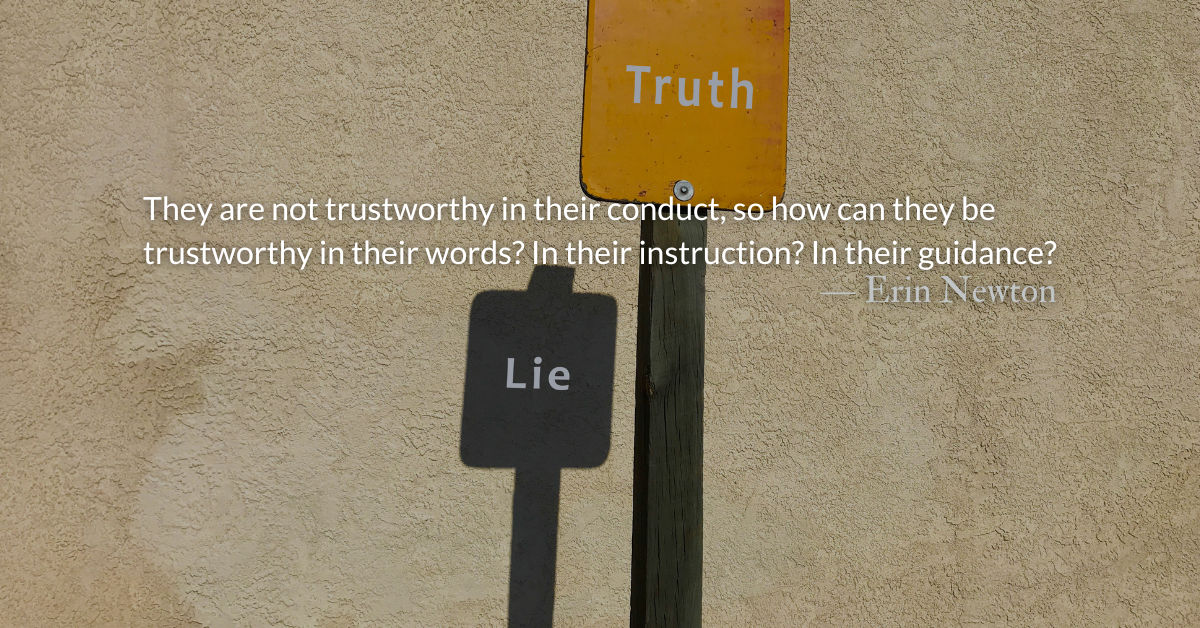
Malachi reports about the dishonesty among the priests. They do not practice justice, and they are unfaithful to their spouses. They are not trustworthy in their conduct, so how can they be trustworthy in their words? In their instruction? In their guidance?

In the end, God is fed up with their empty words.

The preservation of knowledge includes knowing what is true and being able to discern what is false. Christians have attempted to fine-tune the faith until every inch of life is covered. We think we are preserving knowledge, knowing that people are instructed by our interpretations.

But we often fail through our actions. Sometimes we fail through compromise.

What we say about God’s word matters. How we glean truth from the Bible, prayer, experience, and tradition matters. Our desire to have the right answer is noble in and of itself, but if our lives are counter to our words, we weary God.

Not many of us are ordained priests or employed as pastors, ministers, or leaders. When James speaks of teachers, we might think we have escaped such a risky position. However, in our modern era, we become thought leaders on social media. When something we say can be cropped into an inspirational phrase, our words suddenly have more weight. We lead and teach children as parents, aunts, uncles, or elders. As iron sharpens iron, we act as teachers to our friends. 

The priesthood of the believer is not only our ability to approach God with our prayers but also our role in teaching the world. With such a position through Christ, let us learn to speak truth, live truthfully, and not weary the Lord.

Divine Hours Prayer: A Reading

Jesus taught us, saying: “Whoever holds to my commandments and keeps them is the one who loves me; and whoever loves me will be loved by my Father, and I shall love him and reveal myself to him.” — John 14.21

– From The Divine Hours: Prayers for Summertime by Phyllis Tickle.

Read more: Offal Leaders 

Malachi describes a de-commissioning…feces from the animal would be smeared on their faces, representing impurity and death.

Read more: A Broken Rebel’s Prayer

His family must have hoped that their little rebel, like a well-slung stone, might take down the oppressive giant…Instead, he fails miserably.

When God Wants to Quit Church

Links for today’s readings:

Jun 2  Read: Malachi 1 Listen: (2:47) Read: Luke 24 Listen: (6:16)

Scripture Focus: Malachi 1.10-11

10 “Oh, that one of you would shut the temple doors, so that you would not light useless fires on my altar! I am not pleased with you,” says the Lord Almighty, “and I will accept no offering from your hands. 11 My name will be great among the nations, from where the sun rises to where it sets. In every place incense and pure offerings will be brought to me, because my name will be great among the nations,” says the Lord Almighty.

Reflection: When God Wants to Quit Church

By John Tillman

Imagine facing dangerous obstacles and making huge sacrifices to build a church where none exists. Then, when it is up and running, God says, “Lock the doors. Stop coming.”

That’s the opening chapter of Malachi.

It was a moving and inspiring moment when the rebuilt and rededicated temple was functioning again. (Ezra 6.15-18) But soon after temple worship resumed, God wanted to close the temple doors.

What happens when even God doesn’t want to attend worship? What makes God quit church?

Despite all they did to build the building, the people became indifferent and apathetic and treated the temple, and by extension God, with contempt.

One example of contempt, which Malachi highlighted, was sacrificing unacceptable and valueless animals. A main element of temple worship was eating sacrifices in the Lord’s presence, which also provided food for the priests. Israel brought animals so flawed and sickly, no one could, or wanted to, eat them!

That wasn’t all. Malachi went on to condemn witchcraft, adultery, lies, defrauding workers, oppressing the vulnerable, and depriving immigrants and foreigners of justice (Mal 3.5).

The people’s sacrifices broke faith with God and the temple and their actions in the community broke faith with those God loves and protects. They selfishly kept the best of everything for themselves, leaving the vulnerable desperate and the temple defiled. God will quit or close churches with contempt for the vulnerable.

Often (especially when promoting church attendance and involvement), leaders say something similar to, “Just like you can’t love me and hate my wife, you can’t love Jesus and hate his bride, the church.” This well-intentioned, but flawed analogy fails to account for our responsibility to tell the truth about the conduct of a friend’s wife and the conduct of particular churches. If a friend or family member’s spouse is abusive, an addict, cruel, corrupt, or manipulative, love obligates you to address those problems, not pretend they don’t exist.

If you love Jesus, you should love the church as Jesus does, sacrificing and serving her. This part of the analogy is accurate. But when churches operate in wicked or abusive ways, they don’t get a pass. God tells the truth about his temple and Jesus tells the truth about his churches. Love compels us to tell the truth, not ignore it.

Build churches God wants to keep open, remembering that honest critique is not betrayal but love and love rejoices at repentance.

Divine Hours Prayer: The Greeting

Out of Zion, perfect in its beauty, God reveals himself in glory.
Let the heavens declare the rightness of his cause; for God himself is judge. — Psalm 50.2,6

– From The Divine Hours: Prayers for Summertime by Phyllis Tickle.

Read more: All Roads Lead to Jerusalem

We must face our Jerusalem…What shall we say, “Deliver us from this hour?” No. We must say, as Jesus did, “Father, glorify your name!”

Read more: Examine Your Sacrifices

We are still called to works of sacrifice…feed the hungry…welcome the stranger…visit the sick and the prisoner.

If History Rhymes, What Will Your Verse Be?

Links for today’s readings:

Jun 1  Read: Zechariah 14 Listen: (3:52) Read: Luke 23 Listen: (6:39)

Scripture Focus: Zechariah 13.3-9

3 Then the Lord will go out and fight against those nations, as he fights on a day of battle. 4 On that day his feet will stand on the Mount of Olives, east of Jerusalem, and the Mount of Olives will be split in two from east to west, forming a great valley, with half of the mountain moving north and half moving south. 5 You will flee by my mountain valley, for it will extend to Azel. You will flee as you fled from the earthquake in the days of Uzziah king of Judah. Then the Lord my God will come, and all the holy ones with him. 
6 On that day there will be neither sunlight nor cold, frosty darkness. 7 It will be a unique day—a day known only to the Lord—with no distinction between day and night. When evening comes, there will be light. 
8 On that day living water will flow out from Jerusalem, half of it east to the Dead Sea and half of it west to the Mediterranean Sea, in summer and in winter. 9 The Lord will be king over the whole earth. On that day there will be one Lord, and his name the only name.

Reflection: If History Rhymes, What Will Your Verse Be?

By John Tillman

Mark Twain is (probably falsely) credited with the aphorism, “History rhymes.” This is a more nuanced truism than “History Repeating.” The “rhyming” of history does not mean that events are precisely replicated, but that similar events repeat in regular patterns, like poetry.

Like history, biblical prophecy rhymes.

Prophets, like Zechariah, wrote primarily to their contemporary audience about their immediate or not-too-distant future. But these events have layered meanings that were, or will be, fulfilled in the life of Jesus, in our lives today, and in the last days of our cosmos at the renewing of Heaven and Earth.

God parted the sea for Israel to escape from Egypt through the waters. (Ex 14.21-22; Neh 9.11; Isa 63.12) In Zechariah’s vision, God will part a mountain for Jerusalem to escape through a narrow valley. What will God part for us?

In the creation story, God divided the waters to create the waters of the sky and the waters of the seas. (Gen 1.6-7) In Zechariah’s vision, God will cause living waters to flow from Jerusalem, dividing those waters to flow both east and west to all peoples in all directions. What will God provide through us?

Most of Zechariah’s visions focused on the rebuilding and restoration following the devastation of Jerusalem in his day. But he also wrote about the coming devastation and restoration of the cosmos. Like the post-exilic Jews Zechariah wrote to, we know a final catastrophe and victory are coming, but until then, we have a rebuilding and restoration mission (2 Cor 5.18-19). 

Obstacles, whether uncrossable seas or immovable mountains, cannot keep God’s people from his purposes or keep God from coming to us. God makes the way. Nothing can or will separate us from God’s love or from the eternal fellowship of God’s people to come. No catastrophe, consequence, or calamity now or in the final days will compare to the joy and glory to come. (Rom 8.18) After everything, we will be with God, and he will be with us. So what will you do until that day?

Prophets lay down beats that echo in the future and step to the mic, dropping verses about events of their moment. But the beat will go on in our moment and in moments yet to come. What will we say and do when the mic passes to us?

“The powerful play goes on, and you may contribute a verse.” (“O Me! O Life!”)

What will your verse be?

Divine Hours Prayer: The Refrain for the Morning Lessons

My heart is firmly fixed, O God, my heart is fixed; I will sing and make melody. — Psalm 57.7


– From The Divine Hours: Prayers for Summertime by Phyllis Tickle.

Read more: The End of Evil

While it feels like our world is “always winter and never spring” God is coming to make an end of evil.

Read more: Save Yourself (And Us)

We live in a “save yourself” culture. We put ourselves first and save ourselves from everything. This is one reason Jesus is foolish to our culture.

Show Buttons
Hide Buttons
Spur a spiritual rhythm of refreshment right in your inbox
By joining this email list you are giving us permission to send you devotional emails each weekday and to communicate occasionally regarding other aspects of the ministry.
100% Privacy. We don't spam.